

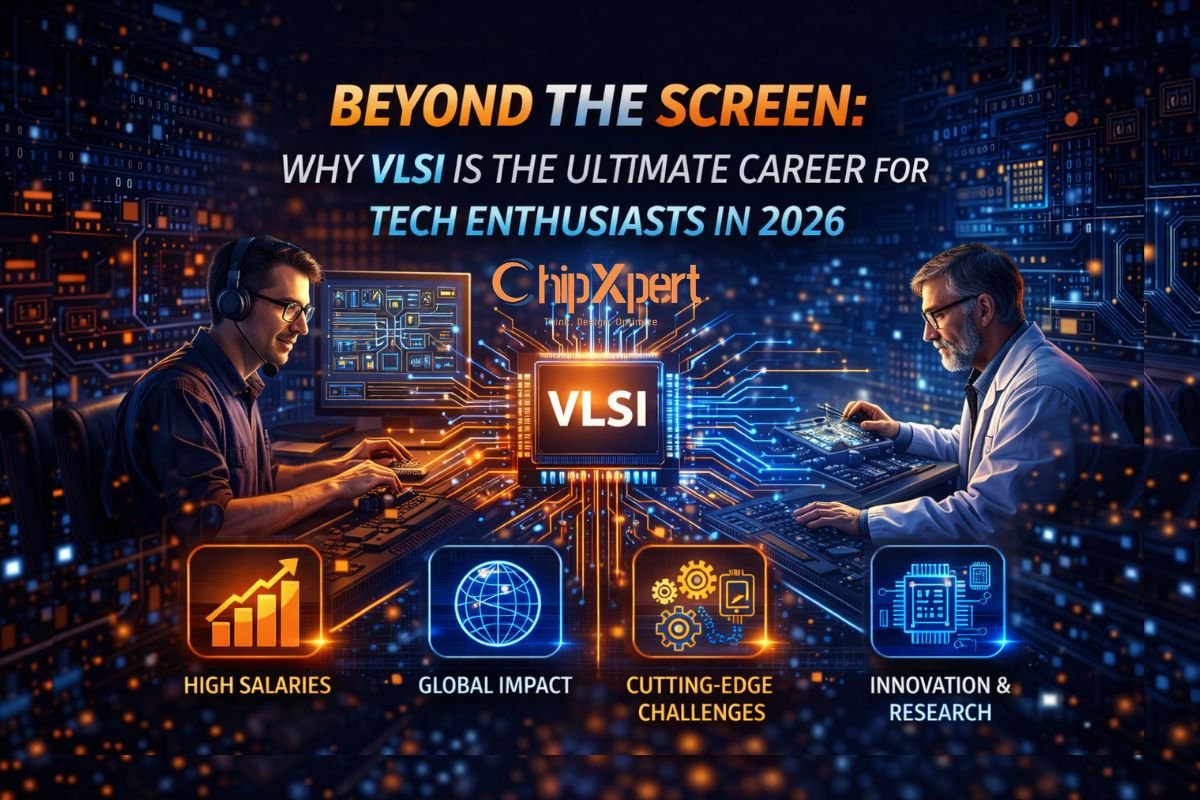
For the last decade, the term tech enthusiast was almost synonymous with software development. The world was obsessed with apps, web platforms, and the cloud. However, as we move through 2026, the pendulum has swung back toward the physical. The “Software is eating the world” era has evolved into the “Silicon is powering the world” era.
If you are someone who is genuinely fascinated by how things work at the atomic level, how billions of calculations happen in a millisecond, or how AI is physically manifested, then Very Large Scale Integration (VLSI) is no longer just a career option, it is the most exciting frontier in technology today.
The Shift from Code to Silicon
In 2026, we are witnessing a “Hardware Renaissance.” The biggest names in tech, Google, Apple, Amazon, and Meta, are no longer just software companies. They have all become chip designers. They realized that to truly innovate in AI, AR, and autonomous systems, they couldn’t just write better code; they had to build better silicon.
This shift has transformed the VLSI career path. It is no longer a niche field for academic researchers. It is a high-stakes, fast-paced industry that requires the same level of creativity and agility as the most advanced software startups. For a tech enthusiast, this means you aren’t just working on another app that might be deleted tomorrow; you are building the physical foundation of human progress.
Why VLSI Stands Out in 2026
If you are weighing your career options, there are three primary reasons why VLSI is currently outperforming traditional tech sectors.
1. Unprecedented Job Stability and Growth
The global chip shortage of the early 2020s taught the world a hard lesson: semiconductors are the new oil. Governments across the globe are now pouring hundreds of billions of dollars into domestic chip manufacturing and design. This “Silicon Sovereignty” movement has created a job market where the demand for skilled VLSI engineers far outstrips the supply. While other tech sectors have seen cooling, the semiconductor industry is in a state of permanent expansion.
2. The “Intellectual High” of Complexity
VLSI is arguably the most complex engineering challenge humans have ever mastered. Designing a 2nm chip involves managing quantum physics, advanced thermodynamics, and massive architectural logic. For a true tech enthusiast, this level of complexity is an addictive intellectual challenge. There is a unique satisfaction in knowing that the circuit you verified or the layout you optimized is being manufactured in the most advanced cleanrooms on the planet.
3. Competitive Compensation and Longevity
The entry-level salaries for VLSI engineers in 2026 have surpassed many software roles. More importantly, VLSI offers better career longevity. In software, frameworks change every three years, and there is a constant pressure to relearn everything. In VLSI, your knowledge of physics, timing analysis, and architectural fundamentals is an accumulating asset. You don’t get “aged out” of VLSI; you become an indispensable veteran whose experience is worth millions.
The Multidisciplinary Playground
One of the biggest misconceptions about VLSI is that it is “just for electronics students.” In 2026, VLSI is a multidisciplinary playground.
- For the Math Lover: There is the world of Static Timing Analysis (STA) and formal verification.
- For the Coder: There is SystemVerilog, UVM, and the creation of EDA (Electronic Design Automation) tools using C++ and Python.
- For the Physics Geek: There is device modeling and the challenge of moving to New Materials like Graphene or Gallium Nitride.
- For the Architect: There is the high-level design of AI accelerators and neural processing units.
Whatever your specific “flavor” of tech enthusiasm, there is a sub-domain in VLSI that will feel like home.
Reality Check: The Barrier to Entry
As an industry analyst, I must be candid: VLSI has a steeper learning curve than web development. You cannot become a VLSI engineer via a weekend bootcamp. It requires a solid foundation in digital logic, CMOS fundamentals, and a commitment to mastering complex EDA tools.
However, this barrier to entry is actually your greatest protection. Because the field is hard to enter, the competition is lower, and your value to the company is much higher. Once you have “broken in,” you are part of an elite global workforce that is literally building the future.
Conclusion: Is it the Right Move for You?
If your enthusiasm for technology is driven by a desire to work on things that are tangible, difficult, and globally significant, then the answer is a resounding yes. VLSI is the ultimate career for those who want to be at the intersection of science and industry.
In the 2026 landscape, every major technological breakthrough—from the next generation of generative AI to the sensors in a bionic limb—begins with a VLSI engineer sitting at a workstation. You aren’t just choosing a job; you are choosing to be an architect of the silicon age. If that doesn’t excite a tech enthusiast, nothing will.
Share your question in comments or talk to our mentor team for batch guidance.
Need Fee, Duration, or Demo Class Details?
Talk to our admin team for the latest batch plan and career guidance.
Contact Admin TeamAsk the Admin Team
Drop your basic question in comments: eligibility, prerequisites, tools, fee range, and placement support.
Our team reviews and responds regularly.