
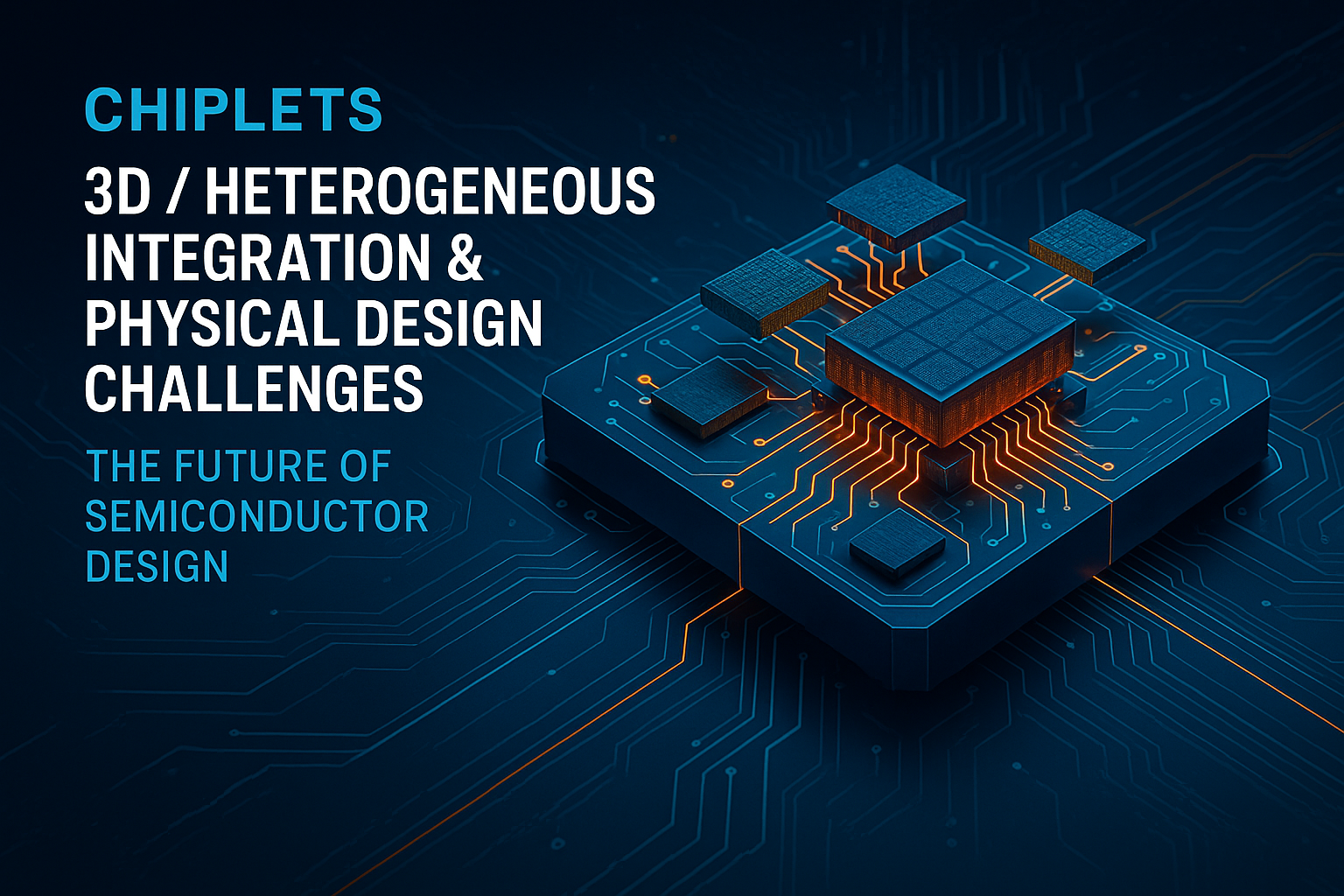
The semiconductor world is changing faster than ever. As traditional monolithic SoCs become harder—and more expensive—to scale, the industry is shifting toward chip-lets, 3D stacking, and heterogeneous integration as the next wave of innovation. These technologies promise higher performance, lower power, and better yield, but they also introduce a brand-new set of physical design challenges that engineers must navigate.
If you’ve been curious about how these advanced packaging approaches work or why they are becoming essential in modern chip design, this article breaks it down in a simple, realistic, and human-friendly way.
Why Chip-lets Are Replacing Traditional SoCs
For years, semiconductor companies have followed Moore’s Law by packing more transistors into a single die. But with sub-10nm nodes becoming extremely expensive and difficult to manufacture, the industry needed a smarter solution.
That’s where chip-lets come in.
A chip-let is essentially a small silicon block that performs a dedicated function—like CPU cores, memory, I/O modules, or accelerators. Instead of building one huge, complex chip, designers now combine these smaller blocks like building bricks.
Benefits of Chip-lets
- Improved yield: Small dies have fewer defects, reducing manufacturing cost.
- Scalability: Designers can mix and match chip-lets for multiple product variants.
- Technology flexibility: Different chip-lets can be manufactured using different nodes (e.g., logic on 5nm, analog on 28nm).
- Shorter development cycle: Teams can re-use proven chip-lets instead of designing everything from scratch.
This modular approach is now the backbone of products like AMD Ryzen processors, Apple’s M-series chips, and even high-performance AI accelerators.
The Rise of 3D & Heterogeneous Integration
While chip-lets provide a horizontal approach, 3D integration takes things vertically.
Stacking layers of silicon—whether memory on logic or multiple logic dies—dramatically reduces interconnect distance and boosts performance. Technologies like TSV (Through-Silicon Via), micro-bumps, and hybrid bonding are enabling these designs.
Why 3D Integration Matters
- Higher bandwidth: Perfect for memory-heavy workloads like AI/ML.
- Smaller footprint: Useful for smartphones, wearables, and compact IoT devices.
- Lower latency: Since dies are closer, signal travel time drops significantly.
- Power reduction: Shorter wires lead to lower dynamic power consumption.
Heterogeneous integration, on the other hand, focuses on bringing together different types of chips—logic, memory, RF, photonics, and more—into a unified package. This allows companies to mix technologies that traditionally don’t work well on the same die.
Physical Design Challenges in the New Era
As promising as chip-lets and 3D packaging are, they introduce some of the toughest physical design challenges engineers have ever faced.
Let’s look at the biggest ones.
1. Interconnect Complexity
Chip-lets rely heavily on advanced interconnects, such as:
- UCIe (Universal Chiplet Interconnect Express)
- EMIB
- Silicon interposers
- High-density RDL (Redistribution Layers)
Ensuring high-speed, low-latency communication between multiple dies requires:
- Precise timing management
- Careful signal integrity optimization
- Robust power delivery network (PDN) design
The complexity is far higher than traditional 2D SoCs.
2. Thermal Management Becomes Critical
Stacking dies one on top of another might help performance, but it creates heat density hotspots. In 3D ICs, heat has fewer paths to escape, increasing the risk of:
- Thermal throttling
- Reliability degradation
- Reduced lifespan
Engineers now rely on advanced cooling techniques, thermal simulations, and even AI-based modeling to predict and optimize heat flow.
3. Power Delivery Challenges
With multiple dies integrated into one package, delivering clean, stable power is not easy. Each chip-let may have different:
- Voltage domains
- Power consumption profiles
- Power integrity requirements
This requires stronger PDNs, multi-layer power grids, and careful decoupling capacitor placement.
4. More Complex Timing Closure
Traditional timing closure focuses on on-chip paths. But in chip-let architectures, timing must be closed across dies, often separated by interposers or RDL layers. This introduces variations in:
- Propagation delays
- Skew
- Crosstalk
- Parasitic effects
Tools are improving, but timing signoff remains one of the hardest tasks in chip-let design.
5. Manufacturing & Yield Challenges
3D integration involves:
- Multiple process steps
- Layer alignment
- Bonding quality control
- TSV integrity checks
Yield becomes a cross-layer issue—one faulty die can impact the entire stack.
6. EDA Tools Still Catching Up
The EDA ecosystem is evolving, but many tools were designed for classic flat SoCs. Today we need:
- Package-aware timing analysis
- Multi-die floorplanning
- 3D thermal-electrical co-simulation
- Co-optimization across silicon and packaging
The concept of System Technology Co-Optimization (STCO) is emerging to address this, but widespread adoption will take time.
The Road Ahead
Chip-lets, 3D stacking, and heterogeneous integration aren’t just trends—they are the foundation of the next decade of semiconductor innovation. From AI accelerators to automotive electronics, nearly every domain will rely on these advanced packaging methods.
However, mastering the physical design challenges is key. Engineers who understand multi-die integration, advanced packaging flows, and system-level co-design will be among the most in-demand professionals in the semiconductor industry.
Share your question in comments or talk to our mentor team for batch guidance.
Need Fee, Duration, or Demo Class Details?
Talk to our admin team for the latest batch plan and career guidance.
Contact Admin TeamAsk the Admin Team
Drop your basic question in comments: eligibility, prerequisites, tools, fee range, and placement support.
Our team reviews and responds regularly.